

Recommended Blogs

Guidewire Testing Holding Releases Back? Build an End-to-End Strategy That Scales
Table of Content
- Why Guidewire Testing Often Fails in Policy, Billing & Claims
- What a Strong Guidewire Testing Strategy Looks Like
- End-to-End Test Strategy for PolicyCenter, BillingCenter & ClaimCenter
- How to Test Guidewire Applications Across Complex Workflows
- Building a Future-Ready Guidewire Test Automation Strategy
- Why Choose TestingXperts for Guidewire Testing Success
- Conclusion
Share On


Insurance executives are speeding up the modernization of their key systems. Platforms like Guidewire are now seen as essential for digital transformation and operational flexibility. According to reports, practically all insurers are using SaaS for their P&C core platforms, underscoring the need to update their legacy systems.
On the other hand, large implementations are still hard, often because they require extensive customization, depend on multiple systems, and take a long time to deliver. Guidewire platforms cover policy, billing, and claims, and they all work together with systems that come before and after them.
Many programs get stuck when they have to test these systems at scale. Without a defined, end-to-end Guidewire testing plan, it becomes harder to predict when releases will occur, quality risks increase, and transformation goals are delayed.
Why Guidewire Testing Often Fails in Policy, Billing & Claims
Most of the time, when Guidewire PolicyCenter testing, Guidewire BillingCenter testing, and Guidewire ClaimCenter testing fail, it’s not because people didn’t try hard enough. They originate from thinking in pieces.
Even though real business processes go through all three, teams frequently test PolicyCenter, BillingCenter, and ClaimCenter separately. When a policy is established in PolicyCenter, it sets up billing schedules that are then linked to claim occurrences. These dependencies are missed until late in the testing process, when testing is segregated, leading to rework and delivery delays.
Another common mistake is relying too heavily on manual validation in complex situations. Because there are so many integrations, manual testing can’t keep up with things like payment gateways, document systems, and third-party data sources.
With inconsistent test data, unstable environments, and late-stage integration testing, the effect is predictable: bugs get through, cycles get longer, and confidence diminishes.
What this truly means is that teams can’t keep up with the growing complexity of Guidewire testing without a single plan.
What a Strong Guidewire Testing Strategy Looks Like
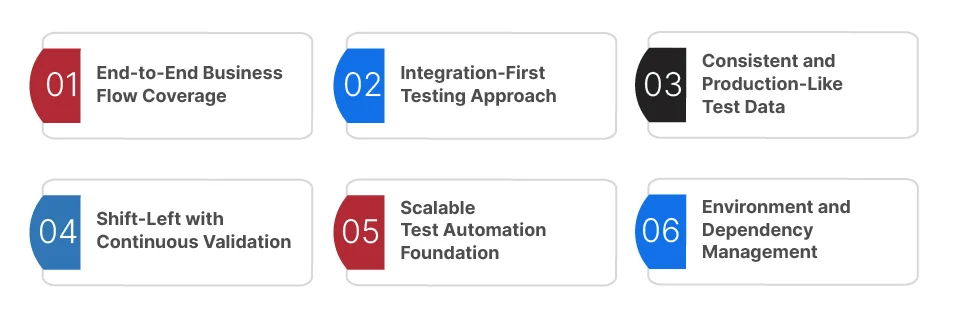
Leaders need a Guidewire testing strategy that aligns with how Policy, Billing, and Claims really work, like connected, data-driven, and always changing, to move from reactive testing to predictable delivery. This is what it looks like in real life:
1. End-to-End Business Flow Coverage
A robust PolicyCenter test approach checks the entire journey, not just modules. Testing must simulate real client scenarios from policy generation through billing and claims to find cross-system bugs early.
2. Integration-First Testing Approach
Because Guidewire relies on other systems, testing should focus on APIs, third-party integrations, and data exchanges early in the cycle, rather than treating integration testing as a final step.
3. Consistent and Production-Like Test Data
Testing claims for reliable Guidewire PolicyBilling hinges on accurate and well-managed test data. Without it, even well-designed test cases don’t reflect how complex things really are, so flaws go unnoticed, and coverage is poor.
4. Shift-Left with Continuous Validation
Testing should start early and keep going through all stages of development. Adding validation to CI/CD pipelines speeds feedback, reduces rework, and builds trust in releases.
5. Scalable Test Automation Foundation
A Guidewire test automation plan that is ready for the future focuses on reusable parts, regression coverage, and stability. This ensures automation can handle growth without becoming a maintenance headache.
6. Environment and Dependency Management
Stable, production-like settings are very important. A good strategy ensures that dependencies between PolicyCenter, BillingCenter, and ClaimCenter are in sync, reducing problems and ensuring tests are run consistently.
End-to-End Test Strategy for PolicyCenter, BillingCenter & ClaimCenter
To develop a good Guidewire policy and a billing claims testing plan, ensure testing aligns with real business processes, not just system boundaries. Here’s how to set up a Guidewire testing plan from start to finish:
1. Map Business Journeys Across Systems
Start by identifying the main insurance tasks, such as getting a quote, paying bills, and processing claims. Ensure testing aligns with these flows so that all Guidewire apps are truly validated from start to finish.
2. Design Scenario-based Test Coverage
Instead of looking at isolated test cases, look at real-world situations. To make Guidewire PolicyCenter testing more thorough and reliable, add edge cases, policy modifications, cancellations, and changes in the claim lifecycle.
3. Validate Cross-system Data Consistency
Ensure data flow correctly between PolicyCenter, BillingCenter, and ClaimCenter. Check the data for financial transactions, policy revisions, and claims to avoid reconciliation issues and inaccuracies later.
4. Prioritize Integration and API Testing Early
Most of the problems in Guidewire ecosystems are caused by integrations. Testing APIs and links to third parties early helps avoid surprises later and strengthens overall Guidewire BillingCenter testing and ClaimCenter validation.
5. Incorporate Regression Across Interconnected Modules
Changes to one system can often affect other systems. To keep things stable and reduce risk during frequent releases, build regression coverage for policy, billing, and claims.
6. Align Testing with Release and Deployment Cycles
Ensure testing occurs at the same time as the agile and release cycles. Continuous validation across environments speeds feedback and supports scaled testing of Guidewire applications.
How to Test Guidewire Applications Across Complex Workflows
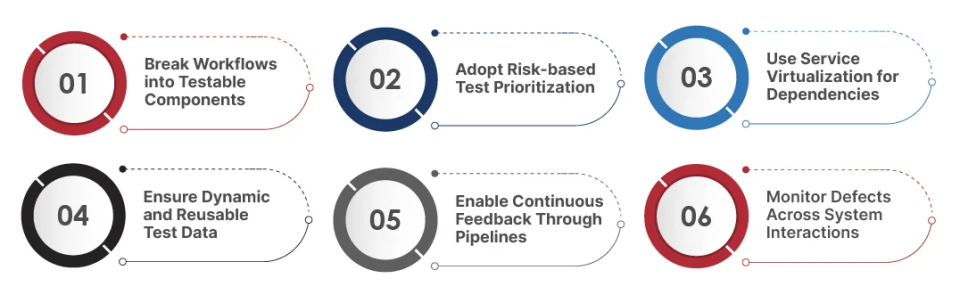
When you test Guidewire systems, you’re not so much checking individual features as you are ensuring that workflows work together. A useful way to test Guidewire applications is to focus on how to handle complexity without losing control.
Break Workflows into Testable Components
Break up big corporate operations into smaller, easier-to-handle routines while keeping track of everything from start to finish. This makes it easier to create, run, and scale tests without missing important dependencies.
Adopt Risk-based Test Prioritization
Not all situations have the same effect. In Guidewire ClaimCenter testing and billing validation, focus your testing on high-risk areas, including customer-facing journeys, financial transactions, and regulatory compliance.
Use Service Virtualization for Dependencies
Sometimes external systems aren’t available or stable. By simulating third-party services, you can keep testing going without breaks, enabling you to cover more complex integration points.
Ensure Dynamic and Reusable Test Data
In systems that change, static data quickly becomes useless. Use dynamic datasets that adapt to the situation to improve accuracy and enhance Guidewire PolicyCenter testing results across multiple workflows.
Enable Continuous Feedback Through Pipelines
Add testing to CI/CD pipelines so that workflows are always checked. Early detection reduces rework and speeds up delivery cycles.
Monitor Defects Across System Interactions
Don’t simply keep track of faults by module; also track how they affect the workflow. This helps identify recurring issues in PolicyCenter, BillingCenter, and ClaimCenter, making testing faster and more effective overall.
Building a Future-Ready Guidewire Test Automation Strategy
As Guidewire ecosystems grow, manual work alone can’t keep up with the speed or quality of releases. A scalable Guidewire test automation technique is based on stability, reuse, and making sure it works with business-critical flows.
Automate High-value And Repeatable Scenarios
Put automation first for workflows with many regressions that have a significant impact on policy, billing, and claims. This speeds up feedback cycles and makes testing Guidewire policy billing claims more consistent.
Design Modular and Reusable Automation Assets
Build automation frameworks with reusable components. This reduces duplication and maintenance team. This method makes it easier for Guidewire PolicyCenter testing and BillingCenter validation to grow over time.
Integrate Automation Into CI/CD Pipelines
Continuous integration and delivery pipelines should include automation. This helps find bugs early and lets releases happen faster and more reliably without needing to be done by hand.
Balance UI And API-level Automation
Too many UI tests slow down execution and increase the likelihood of failures. A good blend of API and UI automation makes things faster, more stable, and covers more ground overall.
Ensure Test Stability and Reduce Flakiness
People don’t trust automation as much when tests are flaky. To achieve solid results in Guidewire ClaimCenter testing and beyond, ensure you use stable scripts, controlled conditions, and adequate synchronization.
Continuously Measure and Optimize Automation ROI
Keep an eye on things like execution time, defect leakage, and coverage. This helps improve the plan and ensures that automation delivers measurable commercial value over time.
Why Choose TestingXperts for Guidewire Testing Success
When you want to scale a Guidewire testing strategy across complicated Policy, Billing, and Claims ecosystems, it’s very important to choose the correct partner. It’s not only about doing things right; it’s also about bringing organization, speed, and predictability.
Deep Domain Expertise in Insurance Workflows
TestingXperts knows the basic insurance procedures for policies, billing, and claims. This lets them conduct more relevant Guidewire PolicyBilling claims testing aligned with real business situations and regulatory standards.
End-to-end Testing Across Guidewire Platforms
TestingXperts offers integrated coverage that ensures validation runs smoothly across interconnected systems rather than just isolated modules. They do everything from Guidewire PolicyCenter testing to billing and claims validation.
Proven Test Automation Frameworks
TestingXperts has a strong Guidewire test automation strategy that focuses on reusable, scalable automation that reduces regression cycles and boosts release confidence without increasing maintenance costs.
Accelerated Delivery with Shift-left Approach
Early testing integration helps find bugs earlier, reducing the need to redo work and enabling faster releases across all Guidewire implementations and updates.
Robust Test Data and Environment Management
TestingXperts ensures test data and conditions are always the same, as you would find in a real production setting. This solves one of the biggest problems with Guidewire testing methods.
Focus On Measurable Business Outcomes
TestingXperts helps businesses achieve predictable, scalable delivery by aligning testing with key performance indicators (KPIs) such as release velocity, defect leakage, and quality benchmarks.
Conclusion
Execution is what makes or breaks the success of a Guidewire change. A broken-up method for testing guidewires can cause delays, faults, and missed business goals. It’s easy to see what the top insurance companies are doing differently. They ensure testing aligns with real workflows, add automation early, and verify that everything works together across Policy, Billing, and Claims.
TestingXperts helps organizations bring this vision to life through comprehensive guidewire testing services, combining deep domain expertise with scalable automation and end-to-end validation. The focus stays on what matters most: faster releases, reduced risk, and consistent quality across complex ecosystems.


Yuvraj Singh
Associate Director
Yuvraj Singh is an accomplished Associate Director of Delivery, renowned for leading strategic quality assurance initiatives that consistently deliver outstanding software outcomes across global markets. With deep expertise in both Property & Casualty (P&C) and Life & Annuities (L&A) insurance domains, Yuvraj excels at bridging the gap between complex business objectives and flawless execution.
FAQs
How do we reduce defect leakage in Guidewire implementations?
Reduce defect leakage by shifting testing earlier, validating end-to-end workflows, and prioritizing high-risk scenarios. Strong test data management and early integration testing help catch issues before release, improving overall quality and minimizing production defects.
What are the key challenges in testing Guidewire integrations, and how can we overcome them?
Guidewire integrations are complex due to multiple third-party systems, unstable environments, and data dependencies. Overcome this with API-first testing, service virtualization, and consistent test data. Early integration validation ensures smoother workflows and fewer surprises during later stages.
How can we effectively integrate Guidewire testing into our CI/CD pipelines?
Integrate testing into CI/CD by automating API and regression tests, triggering validation at every build, and enabling continuous feedback. This ensures faster defect detection, reduces manual effort, and keeps Guidewire releases aligned with agile development cycles.
What are the best practices for managing Guidewire test environments at scale?
- Maintain production-like environments for accuracy
- Synchronize dependencies across Policy, Billing, and Claims
- Use environment provisioning and reset automation
- Monitor stability continuously
- Ensure consistent configurations to avoid test failures
How can scalable automation improve regression efficiency in Guidewire projects?
Scalable automation improves regression by covering high-impact workflows across Policy, Billing, and Claims with reusable components. It reduces execution time, minimizes manual effort, and ensures consistent validation, enabling faster and more reliable releases.
What business benefits can we expect from a unified Guidewire testing strategy?
A unified strategy improves release predictability, reduces defect leakage, and accelerates time to market. It aligns testing with business workflows, enhances customer experience, and helps organizations scale Guidewire implementations with confidence and controlled risk.
How does TestingXperts ensure faster and more reliable Guidewire releases?
TestingXperts combines deep insurance domain expertise with end-to-end Guidewire testing, scalable automation, and shift-left practices. This approach reduces defects early, stabilizes integrations, and accelerates release cycles while maintaining consistent quality across Policy, Billing, and Claims systems.
Discover more